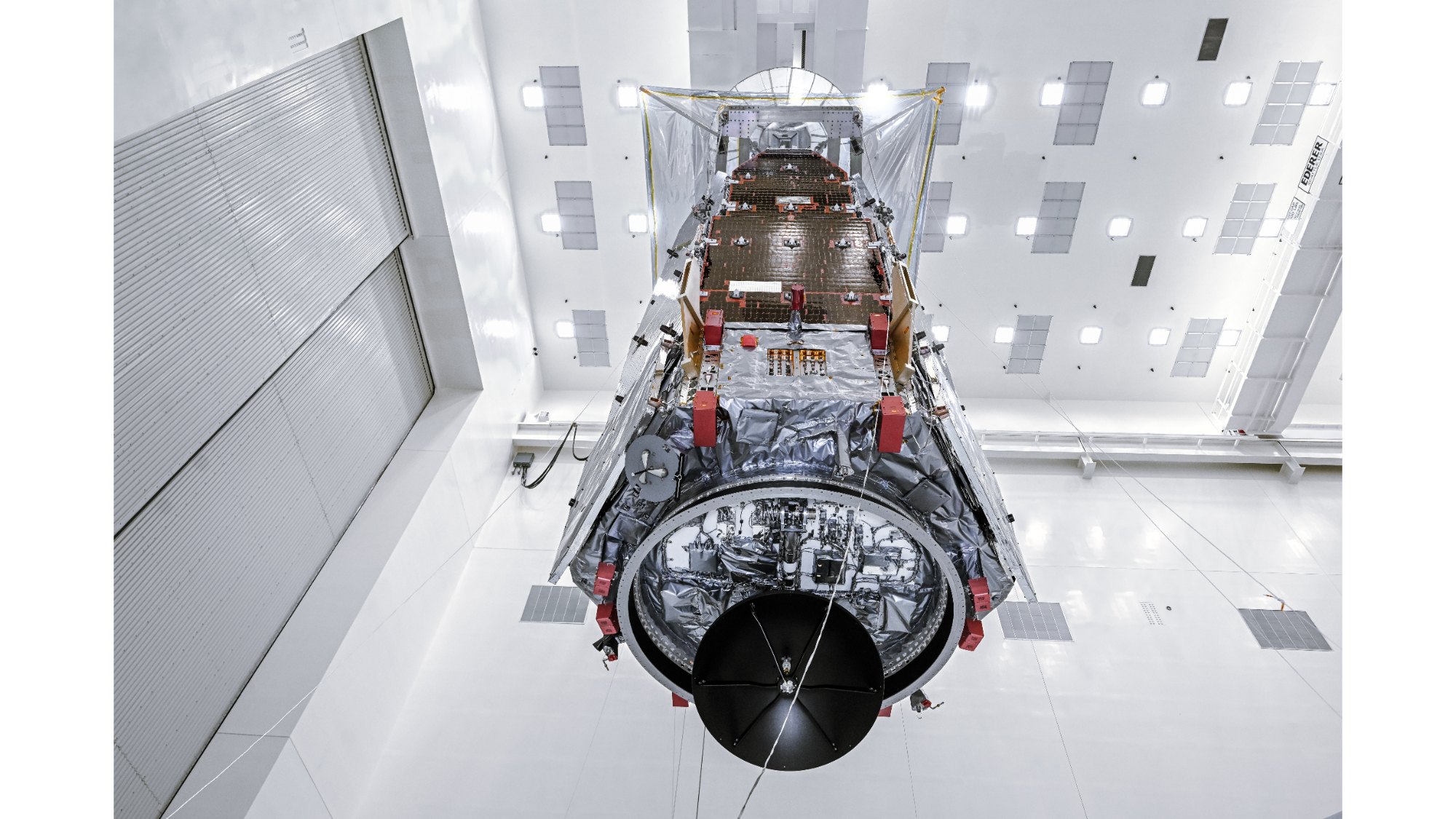
Status: In flight. Updated September 27, 2026. NASA’s Europa Clipper launched in October 2024 to investigate Europa, an icy moon of Jupiter. The spacecraft is designed to ask whether conditions beneath its ice could support life. It is not a mission to detect life directly, and it will not land on Europa.
Why Europa?
Europa appears to have a global salty ocean beneath an ice shell. Liquid water, the chemistry needed for biology and an energy source make it a compelling place to examine habitability. Clipper will study the ice, ocean, surface and surrounding environment together, helping scientists distinguish what is known from what remains inferred. It will also map sites that might matter for future exploration.
Route to Jupiter
The spacecraft uses gravity assists to gain speed without carrying all the required propellant. After launch, its planned path includes a Mars flyby in 2025 and an Earth flyby in December 2026, followed by arrival at Jupiter in 2030. The flybys are navigation milestones; any schedule or trajectory change should be checked against NASA’s mission updates.
What happens at Europa?
Europa Clipper will orbit Jupiter and make 49 close flybys of Europa during its primary science campaign. Repeated passes allow broad coverage of the moon while reducing the time the spacecraft spends inside Jupiter’s intense radiation environment. Its cameras, ice-penetrating radar, spectrometers, magnetometer and other instruments will measure surface composition, investigate the ice shell and probe clues to the ocean below. A detection of an ocean signature or promising chemistry would refine the case for habitability; it would not, by itself, prove life exists.
What to watch next
The next major route milestone is the December 2026 Earth gravity assist. After Jupiter arrival, watch for spacecraft checkout, the first close Europa flybys, and early science results. The distinction between an instrument measurement and a scientific interpretation will matter as findings appear.
Explore more in the Missions directory. Primary sources: NASA mission overview and NASA/JPL mission details.