One Last Look at Earth Before Mars: ESCAPADE Sends Back a Stunning Farewell

A solar panel frames Earth from 38,500 miles away, just hours after a Rocket Lab-built spacecraft fired its engines for Mars.
Three hours after its final close pass by Earth, a spacecraft named Gold looked back. The visible-light image, taken Nov. 9 and released by NASA on Nov. 23, shows Earth’s Western Hemisphere with one of Gold’s solar panels in the foreground. At the time, the probe was about 38,500 miles (62,000 kilometers) from Earth. Its Northern Arizona University camera also captured the scene in infrared, revealing temperature differences across the view. NASA Science
Earth image credit: NASA/UC Berkeley/Northern Arizona University.
Why the twins came back to Earth first
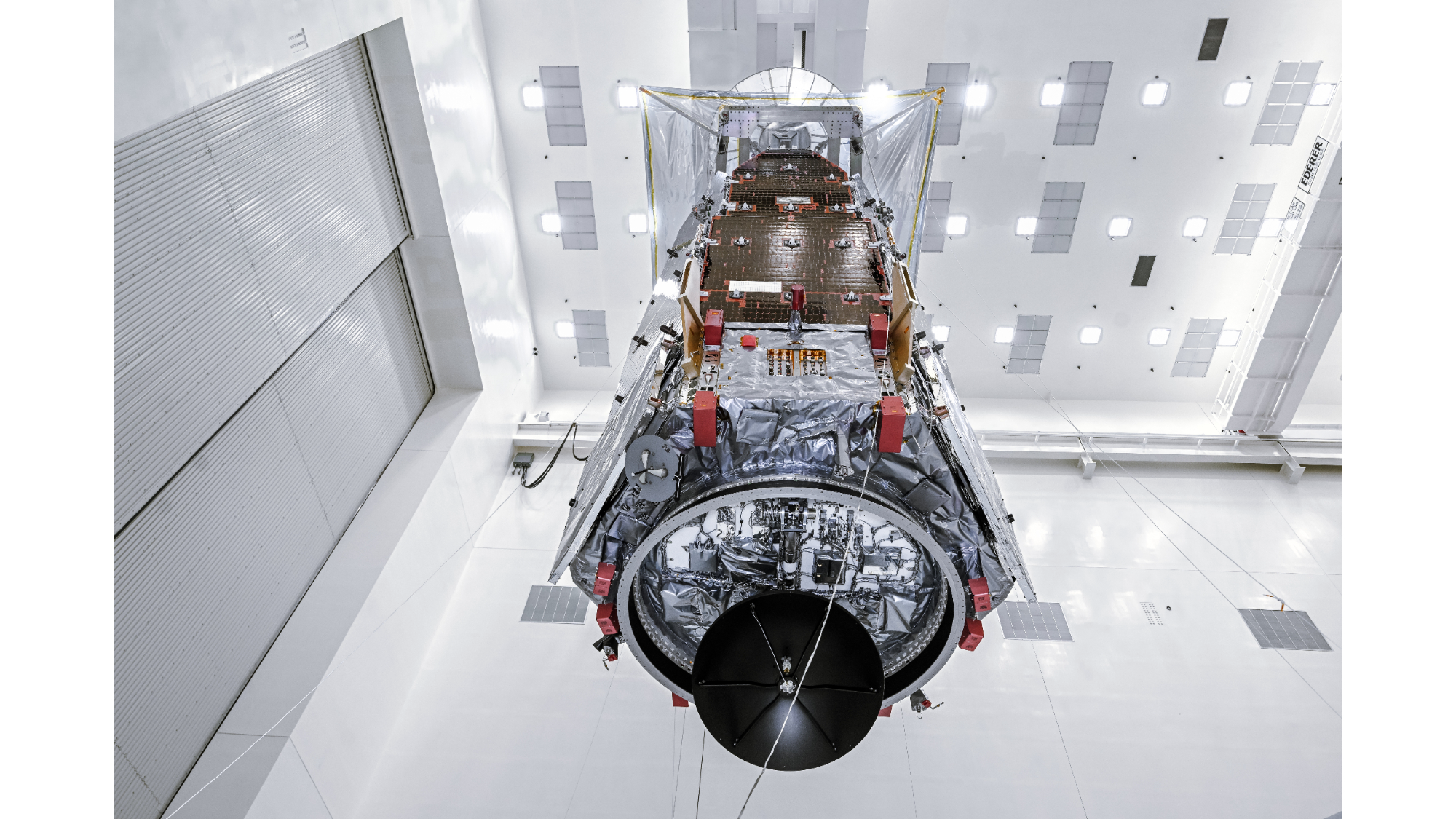
Rocket Lab built Gold and its twin, Blue, for NASA’s ESCAPADE mission, led by UC Berkeley’s Space Sciences Laboratory. They launched aboard Blue Origin’s New Glenn on Nov. 13, 2025, with Earth and Mars on opposite sides of the Sun. The twins spent most of the following year on a looping trajectory around the Sun–Earth L2 region, roughly a million miles from Earth on the side away from the Sun. That gave them time to return to Earth when the planets were better aligned for the trip to Mars. Berkeley News
Blue made its powered flyby on Nov. 7, 2026, and Gold followed on Nov. 9, passing about 650 miles (1,000 kilometers) above Earth’s surface. Each spacecraft combined Earth’s gravity with an engine burn lasting about nine minutes. NASA says these were its first powered Earth flybys to send spacecraft toward Mars. The maneuvers began a roughly 10-month cruise, with Mars orbit insertion planned for Sept. 7, 2027, for Gold and Sept. 9 for Blue. NASA Science · Berkeley News
Why send two spacecraft?
ESCAPADE stands for Escape and Plasma Acceleration and Dynamics Explorers. Its job is to study how the solar wind interacts with Mars and helps strip away its atmosphere. During one phase of the mission, one spacecraft will sample the incoming solar wind farther from Mars while the other measures the planet’s response closer in. Taking both measurements at once helps scientists connect changes in the solar wind to changes in the Martian environment. Berkeley News
About The Author