Tiny Red Galaxies, Giant Cosmic Signals
Peering far into the distant, high-redshift universe, the James Webb telescope has discovered an abundance of small red galaxies known as the Little Red Dots. From their observations, astronomers believe that at least some of these galaxies may be home to growing supermassive black holes at their centers, objects which they believe are embedded in dense gaseous envelopes, an environment suitable for producing high-energy neutrinos.
The James Webb Space Telescope has been peering deeper into the early universe than ever before, and one of its most surprising finds is a population of tiny, red galaxies nicknamed the Little Red Dots (LRDs).
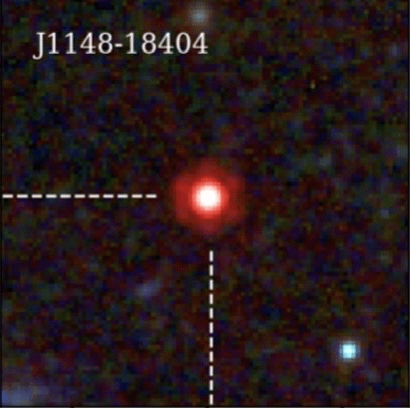
These galaxies appear in the distant, high-redshift universe, which means we are seeing them as they looked billions of years ago, when the cosmos was still young. They are small, faint, and unusually red—but they may be far more powerful than they appear.
Astronomers think at least some Little Red Dots could contain rapidly growing supermassive black holes at their centers. These black holes may be hidden inside thick envelopes of gas, making them difficult to study directly. But that dense, energetic environment is exactly the kind of place where particles can be accelerated to extreme speeds.
That matters because these conditions may be able to produce high-energy neutrinos: tiny, nearly massless particles that can travel across the universe almost undisturbed. Neutrinos are often called “ghost particles” because they rarely interact with matter. Billions pass through Earth—and through us—every second without leaving a trace.
If Little Red Dots are producing neutrinos, they could give scientists a new way to study some of the earliest black holes in the universe. Instead of relying only on light, astronomers may be able to use neutrinos as cosmic messengers from places too dense, dusty, or distant to observe clearly.
For now, the connection is still being investigated. But the idea is exciting: some of the smallest red smudges in Webb’s images may be hiding powerful black holes—and sending ghostly signals across billions of light-years to Earth.
About The Author