The Lineup:
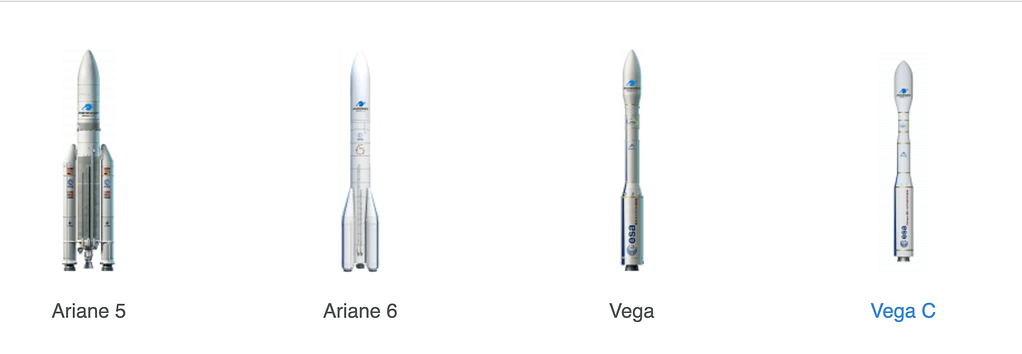
Ariane 5
Ariane 5 is a European Space Agency (ESA) heavy-lift launch vehicle for the deployment of large payloads into geostationary transfer orbit and low Earth orbit. It was developed in the 1990s as a follow-up to the Ariane 4 rocket, which had been in service since 1988. The Ariane 5 has become one of the most reliable and successful heavy-lift launch vehicles in the world, with over 100 successful launches to date.
The Ariane 5 is a two-stage rocket that stands 53 meters (174 feet) tall and has a diameter of 5.4 meters (17.7 feet). It can lift payloads of up to 10,000 kg (22,046 lbs) into geostationary transfer orbit and up to 21,000 kg (46,297 lbs) into low Earth orbit. It is powered by liquid propulsion systems and uses a modular design, allowing it to be customized for different missions.
The Ariane 5 has a payload fairing with a diameter of 5.4 meters (17.7 feet) and a length of 12.8 meters (42 feet). It can accommodate a wide range of payloads, including communications satellites, Earth observation satellites, science and technology missions, and human spaceflight missions.
The first stage of the Ariane 5, called the EPC (Core Cryogenic Stage), is powered by a Vulcain 2 engine and liquid hydrogen and liquid oxygen propellants. It is 29.8 meters (97.8 feet) long and 5.4 meters (17.7 feet) in diameter. The second stage, called the ESC-A (Cryogenic Upper Stage), is powered by a HM7B engine and liquid hydrogen and liquid oxygen propellants. It is 13.5 meters (44.3 feet) long and 5.4 meters (17.7 feet) in diameter.
Ariane 6 (under development)
Ariane 6 is a new rocket under development by the European Space Agency (ESA) as a more cost-effective and flexible successor to the Ariane 5. It is designed to be able to launch a wide range of payloads into various orbits, including low Earth orbit, medium Earth orbit, and geostationary transfer orbit. The Ariane 6 will have two versions: the Ariane 62, which has two solid rocket boosters, and the Ariane 64, which has four solid rocket boosters.
The Ariane 6 will be a two-stage rocket that stands 62 meters (203 feet) tall and has a diameter of 5.4 meters (17.7 feet). It will be powered by liquid propulsion systems and will use a modular design, allowing it to be customized for different missions. The Ariane 6 will have a payload fairing with a diameter of 5.4 meters (17.7 feet) and a length of 12.8 meters (42 feet). It will be able to accommodate a wide range of payloads, including communications satellites, Earth observation satellites, science and technology missions, and human spaceflight missions.
The first stage of the Ariane 6, called the P120C, is a solid propulsion motor powered by HTPB (Hydroxyl-Terminated PolyButadiene) fuel. It is 12.7 meters (41.7 feet) long and 5.4 meters (17.7 feet) in diameter. The second stage, called the Vinci, is a liquid propulsion system powered by liquid hydrogen and liquid oxygen propellants. It is 14.5 meters (47.6 feet) long and 5.4 meters (17.7 feet) in diameter.
The Ariane 6 is currently in the testing and development phase, with its first launch scheduled for 2023. It is expected to significantly reduce the cost of spaceflight for the agency.
VEGA
Vega is a European Space Agency (ESA) small-class launch vehicle for the deployment of small payloads into low Earth orbit. It was developed in the 2000s as a lightweight, low-cost alternative to other European launch vehicles. The Vega C, a upgraded version of the Vega rocket, made its inaugural flight on August 14, 2021.
VEGA C
The Vega C is a four-stage rocket that stands 31 meters (101 feet) tall and has a diameter of 3 meters (9.8 feet). It can lift payloads of up to 4,000 kg (8,818 lbs) into low Earth orbit and 2,500 kg (5,511 lbs) into a Sun-synchronous orbit. It is powered by solid and liquid propulsion systems and uses a modular design, allowing it to be customized for different missions.
The Vega C has a payload fairing with a diameter of 2.6 meters (8.5 feet) and a length of 6.9 meters (22.6 feet). It can accommodate a variety of payloads, including Earth observation satellites, science and technology missions, and small spacecraft for commercial customers.
The first stage of the Vega C, called the P120C, is a solid propulsion motor powered by HTPB (Hydroxyl-Terminated PolyButadiene) fuel. It is 12.7 meters (41.7 feet) long and 3 meters (9.8 feet) in diameter. The second stage, called the Zefiro 40, is a solid propulsion motor powered by HTPB fuel. It is 4 meters (13.1 feet) long and 2.6 meters (8.5 feet) in diameter. The third stage, called the Zefiro 9, is a solid propulsion motor powered by HTPB fuel. It is 2.9 meters (9.5 feet) long and 2.6 meters (8.5 feet) in diameter. The fourth stage, called the AVUM, is a liquid propulsion system powered by monomethylhydrazine (MMH) and nitrogen tetroxide (NTO) propellants. It is 1.9 meters (6.2 feet) long and 2.6 meters (8.5 feet) in diameter.
The Vega C made its inaugural flight on August 14, 2021, successfully deploying the UAE’s FalconEye 2 Earth observation satellite into orbit. Its second mission, which took place on December 20, 2022, ended prematurely due to a pressure drop in the second stage’s engine, resulting in the loss of two payloads.