Astronomers keep finding new moons of Jupiter and Saturn
Astronomers have found four new moons orbiting Jupiter and 11 new moons around Saturn.
The outer solar system is getting more crowded. Astronomers continue to discover new moons orbiting Jupiter and Saturn, pushing the known totals higher and reshaping our understanding of how these planetary systems formed and evolved.
Recent surveys using increasingly sensitive telescopes have revealed dozens of previously undetected moons—most of them small, irregular, and orbiting far from their parent planets.
A Growing Census of Moons

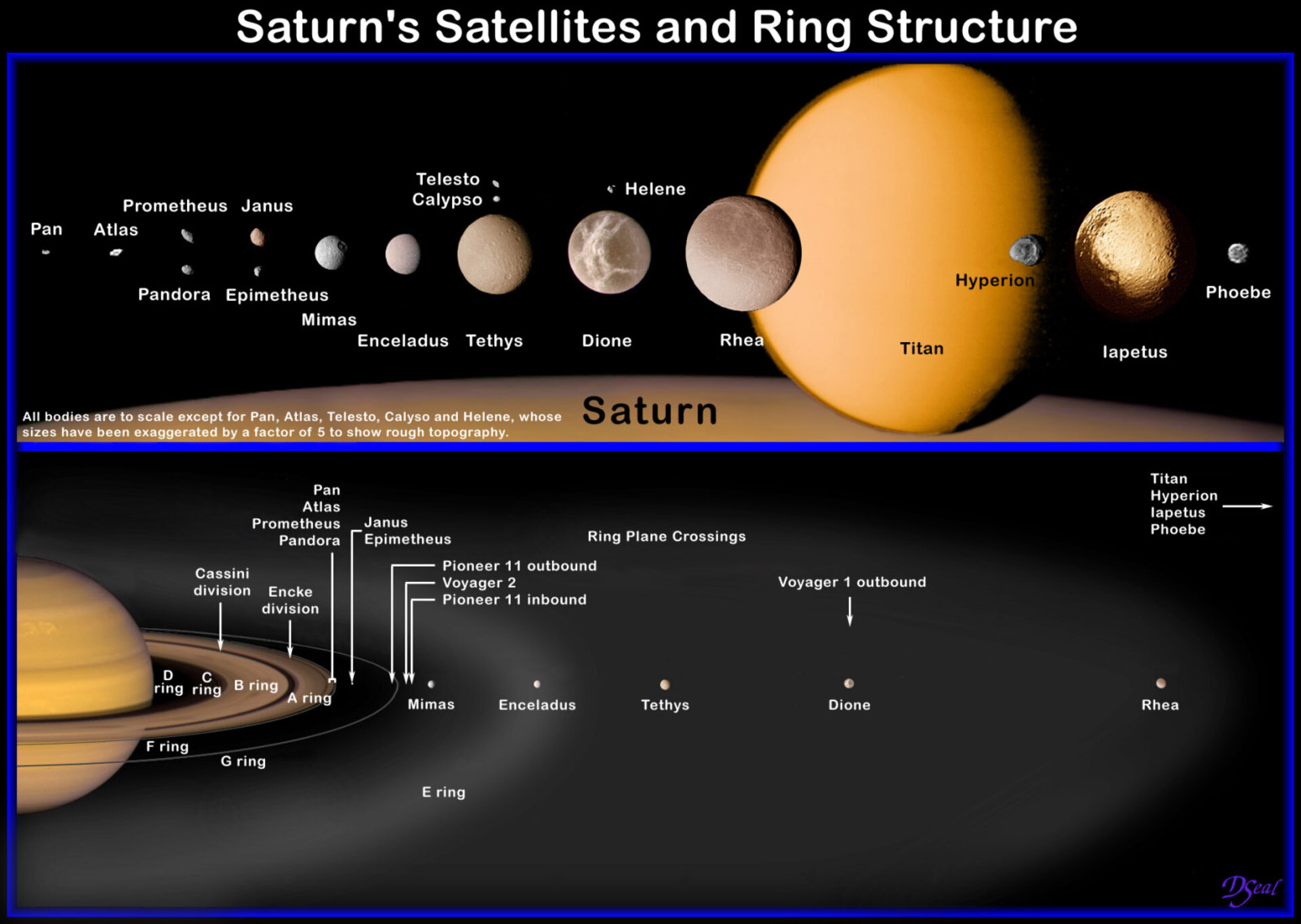
Jupiter and Saturn already host the largest known collections of moons in the solar system. With each new discovery, astronomers are finding that these systems are far more complex than once thought.
Unlike the large, well-known moons—such as Europa or Titan—many of the newly identified objects are:
- Only a few kilometers across
- Irregular in shape
- Located in distant, highly elliptical orbits
Many also orbit in retrograde, meaning they move opposite the planet’s rotation—an important clue to their origin.
Captured Fragments, Not Formed Worlds
The growing population of small moons suggests that many were not formed alongside their host planets. Instead, astronomers believe they are captured objects, likely remnants of collisions in the early solar system.
Over time, larger captured bodies may have broken apart through impacts or gravitational interactions, creating clusters of smaller moons that share similar orbital characteristics.
These fragmented systems offer a kind of fossil record:
👉 Evidence of the chaotic environment that existed during planet formation

Technology Driving Discovery
The pace of discovery has accelerated thanks to improvements in observational techniques. Wide-field surveys and long-exposure imaging allow astronomers to detect extremely faint objects that were previously invisible.
By tracking motion over time, researchers can distinguish small moons from background stars and confirm their orbits around Jupiter or Saturn.
As telescope sensitivity continues to improve, more discoveries are expected—suggesting that the current moon counts may still be incomplete.
Why It Matters
While these newly discovered moons are small, their significance is large.
They help scientists:
- Understand how giant planets capture and retain objects
- Reconstruct the collision history of the outer solar system
- Refine models of planetary system formation
They also challenge a simple idea: that a planet’s moons are a fixed, stable system.
Instead, Jupiter and Saturn appear to host dynamic, evolving populations—systems still revealing their complexity billions of years after formation.
Final Thought
Each new moon adds detail to a much larger story.
Jupiter and Saturn are not just planets with satellites—they are gravitational systems shaped by capture, collision, and time. And as detection methods improve, astronomers are finding that these systems are far from fully mapped.
The outer solar system, it turns out, is still being discovered.
About The Author